
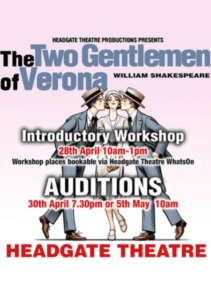
Headgate Theatre Productions are excited to confirm the audition arrangements for the first of our two exciting plays in the autumn season: The Two Gentlemen of Verona (Shakespeare). To be directed by Sheila Foster, founder of the Wivenhoe Open Air Shakespeare company.
Production week: w/c Sunday 13th October
Rehearsals: Wednesday and Sunday evenings from end June (precise arrangements to be confirmed once cast)
Introductory Workshop: Sunday 28th April – 10am to 1pm
On the day, Sheila will explain her vision and will explore extracts from the text. It is not compulsory to attend the workshop in order to audition.
Workshop places bookable via https://www.ticketsource.co.uk/headgatecommunity/t-eavapoy
Auditions: Tuesday 30th April at 7.30pm or Sunday 5th May at 10am
Our production is set in the late 1920s, with feckless young men, free thinking women and knowing servants pushing the boundaries of polite society.
Two close friends have grown up together and are inseparable, until Valentine leaves home to see what kind of a life he can make for himself in the big city. He’s disgruntled that Proteus won’t go with him, but his friend has just begun to woo Julia, and is hoping her father will come round to the idea of their marriage. After they part, Fate, (or rather Proteus’ father!), sends him after Valentine to Milan, where he is enjoying the attentions of the lovely Sylvia, who dazzles them both.
The ties of friendship are severely tested by jealousy, betrayal and a band of brigands.
Shakespeare’s earliest comedy has echoes of the later plays, with disguise, anger, despair, transformational woods, forgiveness, clownish servants – and a dog.
Anyone for tennis?
Casting notes
Click here to download these casting notes
N.B. We are setting the play in the late 1920s. Think P.G. Wodehouse’s Jeeves and Wooster stories, or Scott Fitzgerald’s The Great Gatsby. There are several characters who only appear in one half or the other, and doubling is a possibility.
(Numbers in the brackets after each description denote which scenes each character is in.)
Proteus and Valentine should be of an age – lifelong friends – very close. Late teens, or early 20s. Setting out on life and off to Milan to “seek preferment out” after living in Verona all their lives. This is a bit of a “bromance” and of course boys were brought up in the company of boys, and without close contact with girls, both in Shakespeare’s time and in 1920s England, so friendships are inevitably close, while women are almost a different species – to be admired and fallen in love with.
Proteus is not sure what he wants, easily falls in love, and then forgets his former love. Devoted to Valentine – but betrays him when love for the same woman comes between them. (1.1, 1.3, 2.2, 2.4, 2.6, 3.1, 3.2, 4.2, 4.4, 5.2, 5.4)
Valentine is open-hearted, confident and trusting, and wants to go out and see what the world has to offer. He would like his close friend to go with him, but accepts that his path lies elsewhere. A thoroughly nice chap! However, he does try to make Proteus ashamed of letting the love for a woman prevent him from exploring the world. (1.1, 2.1, 2.4, 3.1, 4.1, 4.4, 5.4)
Julia – similar age group to Proteus & Valentine – could be a bit younger. She is of a reasonably well-off respectable household – she is in love for the first time with Proteus, and has fallen heavily for him He treats her dreadfully, but for some reason this doesn’t put her off, and she is very tenacious in pursuing him. (1.2, 2.2, 2.7, 4.2, 4.4, 5.2, 5.4)
Lucetta is Julia’s “waiting woman” – could be paid companion, poor relation, or lady’s maid. Could be same age or a bit older – but Julia does call her “girl”. Enjoys a real friendship with Julia, and her loyalty is to Julia first and foremost. (1.2, 2.7)
Antonio – Proteus’ father. He wants the best for his son, and seeing his son’s friend Valentine setting off to explore a new environment, he wants his son to go too. He likes to be seen as decisive, but needs the reassurance of advice. (1.3)
Pantino – Antonio’s servant/Butler. He relays Antonio’s brother’s suggestions to Antonio about sending Proteus away- but maybe he adds some of his own ideas to the reported speech? (1.3, 2.2, 2.3)
Speed is Valentine’s servant – and his quick wit and energy make his name appropriate. (1.1, 2.1, 2.4, 2.5, 3.1, 4.1)
Lance is Proteus’s servant. He is quite cynical and less optimistic than Speed – but they get on. He has a dog called Crab, to whom and about whom he talks. Could be a real, trained dog? Or a dog on wheels? Or even a puppet – maybe a way of Lance expressing himself? He likes to deliberately mis-hear words, to twist the meanings of them round for fun. (2.3, 2.5, 3.1)
The Duke of Milan – His word is law in Milan. He is Sylvia’s father and concerned that she should make a good marriage, and not throw her life away on someone who might not be good for her. Status-conscious. (2.4, 3.1, 3.2, 5.2, 5.4)
Sylvia – Beautiful, rich, daughter of the Duke of Milan pursued by many suitors – but also wise, and when she chooses Valentine, loyal and determined. (2.1, 2.4, 4.2, 4.3, 4.4, 5.1, 5.3, 5.4)
Thurio – one of the many young men who are wooing Sylvia. Is he an idiot? Or just overshadowed by our main protagonists? (2.4, 3.2, 4.2, 5.2)
Eglamour – At first there is a suggestion that he is a suitor to Sylvia, but later he appears more as an avuncular figure, helping Sylvia to leave her father’s house to be with Valentine – an agent of her elopement. To be discussed! (4.3, 5.1)
Host (M or F) of Julia’s lodgings in Milan. Supports and tries to cheer Julia (Sebastian) up, and gives information. (4.2)
Three outlaws (there could certainly be more in the gang. Disaffected gentlemen (some of them!) who live in the woods outside Milan. (4.1, 5.1, 5.3)
There may be additional servants to the Duke – there might well be more – there is one scene which might be a party scene, where there could also be guests. Some doubling of smaller parts may be offered.